Claude Opus 4.6: What Anthropic's New AI Means for Creators
Anthropic just released Claude Opus 4.6 — and it's not just another incremental model update. Launched on February 5, 2026, this release introduces agent teams, a 1 million token context window, adaptive thinking, and benchmark scores that put it ahead of GPT-5.2 on economically valuable tasks.
For creative teams and agencies using AI to power their production workflows, Opus 4.6 represents a shift in what a single AI system can handle end-to-end. Let's break down the key features and what they mean in practice.
Agent Teams: Parallel AI Workers for Complex Projects
The headline feature is agent teams — a system where multiple AI agents split a large task into segments, each owning its piece and coordinating directly with the others. Instead of one agent working through tasks sequentially, you can now distribute work across a team of specialized agents.
Why this matters for creative production:
- Parallel research and drafting — one agent pulls reference material while another drafts copy and a third generates layout concepts
- Multi-asset campaigns — different agents handle different deliverables (social posts, email headers, video scripts) simultaneously
- Quality assurance — dedicated agents can review output from other agents, catching inconsistencies before human review
This is a fundamental change in how AI-assisted workflows operate. Previous models handled one task at a time. Agent teams turn Claude into a coordinated production unit.
1 Million Token Context Window
Opus 4.6 is the first Opus-class model with a 1M token context window in beta. That's roughly 750,000 words — enough to hold an entire brand guideline document, a quarter's worth of campaign briefs, and a full project history in a single conversation.
Practical applications:
- Brand consistency — load your complete brand guide, voice guidelines, and style references into a single session. The model retains all of it as it generates content
- Long-form production — handle entire video scripts, multi-chapter content series, or comprehensive campaign strategies without losing context
- Codebase analysis — for teams building custom creative tools, Opus 4.6 can analyze and modify larger codebases reliably, with 76% accuracy on needle-in-haystack retrieval versus 18.5% for Sonnet 4.5
Combined with a new context compaction feature that automatically summarizes older content during long tasks, the model stays sharp even in marathon sessions.
Adaptive Thinking: Smarter Resource Allocation
Opus 4.6 introduces adaptive thinking — the model autonomously determines when a problem benefits from extended reasoning and allocates processing power accordingly. You can also control this with four effort levels: low, medium, high (default), and max.
How creative teams can use this:
- Quick iterations — set effort to low for rapid brainstorming and concept variations
- Production-ready output — use high or max effort for final copy, detailed scripts, or complex layouts that need to be close to finished quality on the first pass
- Cost control — lower effort levels cost less, so you can budget AI spend intelligently across different phases of production
This flexibility means you're not paying premium prices for every interaction. Quick brainstorming gets the fast, affordable treatment. Final deliverables get the full reasoning power.
Benchmark Performance: The Numbers That Matter
Opus 4.6 isn't just marketing polish — the benchmarks back it up:
| Benchmark | What it measures | Result |
|---|---|---|
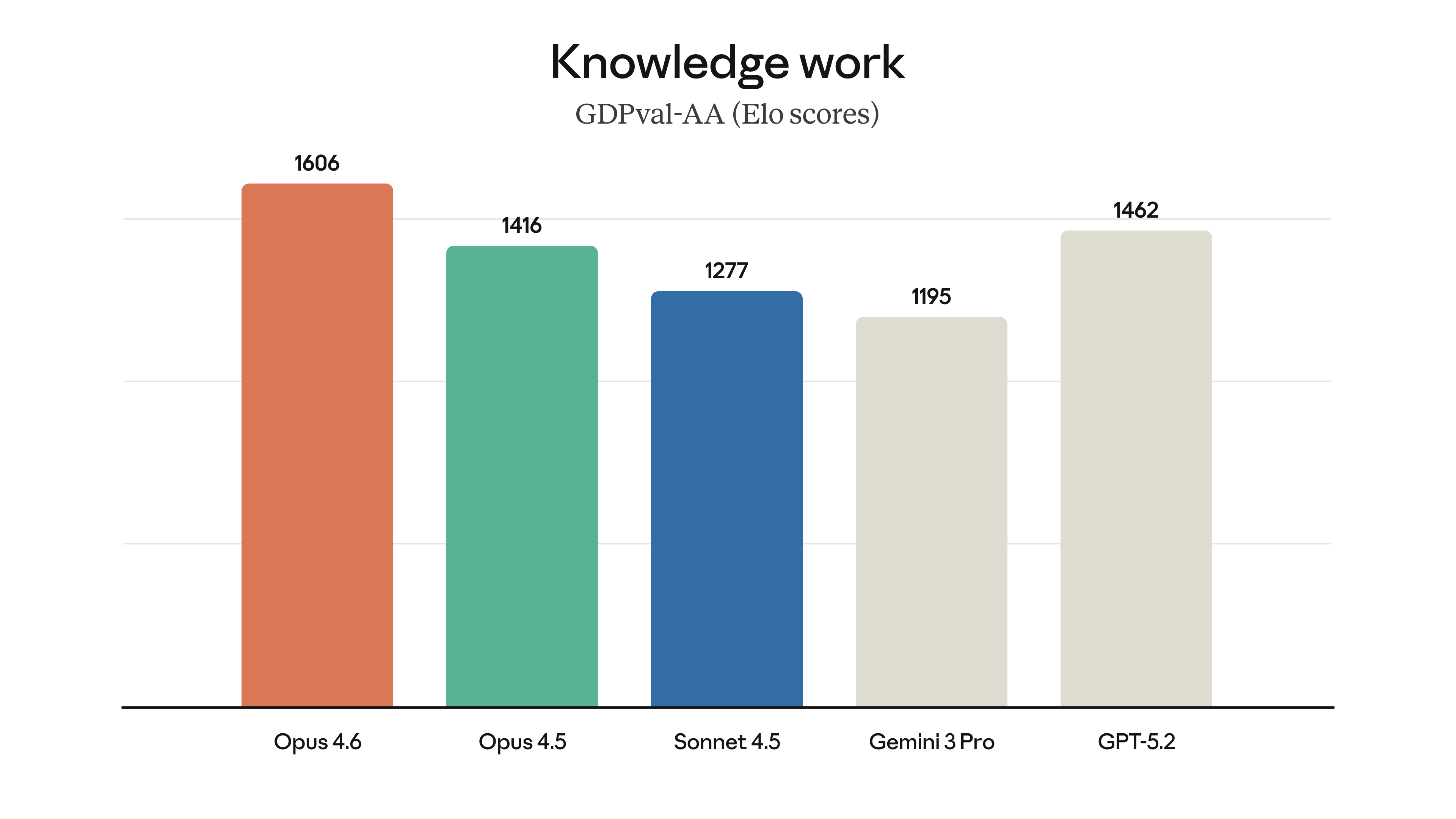
| GDPval-AA | Economically valuable knowledge work | Outperforms GPT-5.2 by ~144 Elo points |
| Terminal-Bench 2.0 | Agentic coding tasks | Highest score among all models |
| Humanity's Last Exam | Multidisciplinary reasoning | Leads frontier models |
| BrowseComp | Finding difficult information | Top performer |
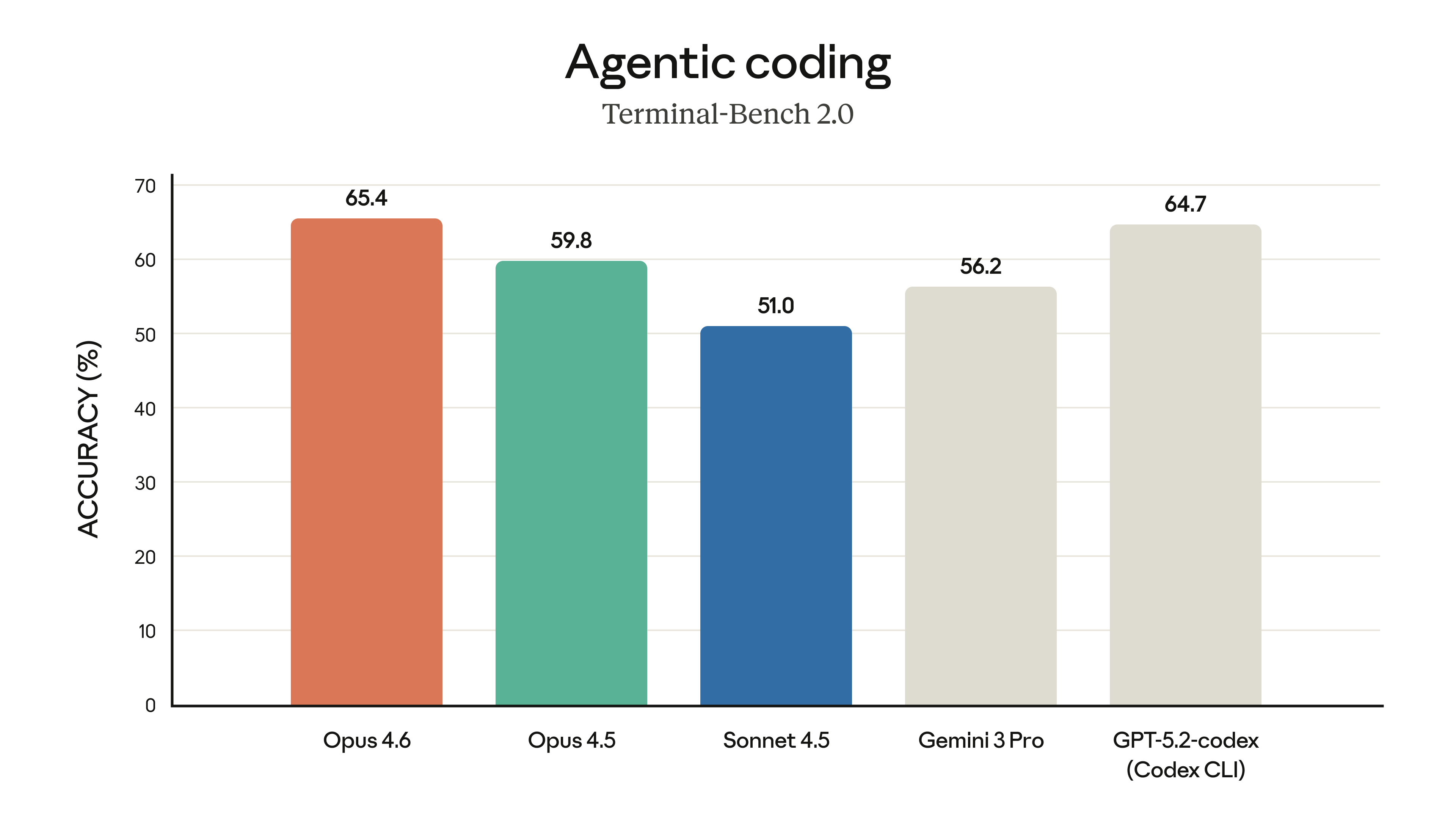
The GDPval-AA score is particularly relevant for creative agencies. This benchmark measures performance on the kind of knowledge work that actually generates economic value — research, analysis, document creation, and complex problem-solving. Outperforming GPT-5.2 by 144 Elo points means measurably better results on real-world tasks.
Enterprise Integrations: Excel, PowerPoint, and Beyond
Anthropic is pushing hard into the tools creative and business teams already use:
- Claude in Excel — enhanced for complex multi-step data tasks like campaign performance analysis, budget modeling, and audience segmentation
- Claude in PowerPoint (research preview) — generates presentations that maintain your design system's consistency, so pitch decks and client presentations start closer to final quality
- 128k output tokens — the model can now generate much longer outputs in a single pass, which means complete documents, detailed scripts, or comprehensive reports without truncation
For agencies that spend hours formatting decks and wrangling spreadsheets, these integrations address real time sinks.
Safety and Reliability
One detail worth noting: Opus 4.6 has the lowest over-refusal rate among recent Claude models. Previous versions sometimes declined legitimate creative requests due to overly cautious safety filters. This version strikes a better balance — it's still safe, but it won't refuse reasonable creative tasks unnecessarily.
The model also includes six new cybersecurity detection probes. For teams handling sensitive client data or intellectual property, this adds a layer of protection that matters.
What This Means for Creative Workflows
Claude Opus 4.6 changes the equation for AI-powered creative production in three key ways:
- Scale without linearity — agent teams mean you can throw more complex, multi-deliverable projects at AI without proportionally increasing your time investment
- Context without compromise — the 1M token window means your AI assistant actually remembers your brand, your history, and your preferences across an entire project
- Quality per dollar — adaptive thinking lets you match AI processing power to the task at hand, so you're not overpaying for brainstorming or under-investing in final output
The model is available now on claude.ai, the API, and all major cloud platforms. Pricing remains at $5/$25 per million tokens for standard usage, with the API model identifier claude-opus-4-6.
Whether you're a creative agency scaling content production, a marketing team building AI-powered workflows, or a production studio looking for smarter automation, Opus 4.6 is the kind of upgrade that doesn't just do things faster — it enables workflows that weren't possible before.