Veo 3.1 Lite: Google Cuts AI Video API Costs in Half
Google's Veo 3.1 Lite is the cheapest AI video generation API from a major provider in 2026. At $0.05 per second for 720p and $0.08 per second for 1080p, it undercuts the existing Veo 3.1 Fast tier by more than 50% while matching its generation speed. For creative teams and developers building video at scale — ad variations, product demos, social content — this changes the math on what's economically viable through an API.
The model launched on March 31, 2026 through the Gemini API and Google AI Studio. It arrives at a pivotal moment: OpenAI shut down Sora and its API just one week earlier, leaving a vacuum in the programmatic AI video space. Google isn't just filling that gap — it's pricing aggressively to own it.
Here's what Veo 3.1 Lite actually delivers, how it stacks up against competing APIs, and what this pricing shift means for production workflows.
What Veo 3.1 Lite Actually Is
Veo 3.1 Lite is a diffusion-based video generation model optimized for high-volume, cost-sensitive applications. It's not a stripped-down demo — it's a production-grade API endpoint designed for developers who need to generate hundreds or thousands of clips without burning through their budget.
Core Capabilities
- Text-to-Video: Generate video from natural language prompts (up to 1,024 tokens)
- Image-to-Video: Animate a still image into a video clip
- Native audio: Ambient and environmental sound generated automatically, synced to visual content
- Flexible framing: Landscape (16:9) and portrait (9:16) orientations
- Resolution options: 720p and 1080p output
- Duration control: 4, 6, or 8-second clips with per-second billing
The model ID is veo-3.1-lite-generate-preview, accessible through the Gemini API's paid tier.
What It Doesn't Do
Veo 3.1 Lite is intentionally scoped. These limitations keep costs low:
- No 4K output — capped at 1080p (the full Veo 3.1 supports 4K)
- No video extension — you can't extend a generated clip beyond its initial duration
- No advanced dialogue audio — ambient sound is included, but complex speech and dialogue generation requires the full Veo 3.1 tier
- No upscaling — though Google announced a separate Veo upscaling capability on Vertex AI
For most social media, ad, and web content, 1080p at 8 seconds is more than sufficient. The 4K limitation only matters for broadcast or cinema-grade production.
The Full Veo Pricing Breakdown
Google now offers three tiers in its Veo model family, and an April 7 price reduction on Veo 3.1 Fast makes the lineup even more competitive:
| Model | 720p | 1080p | 4K | Speed | Video Extension |
|---|---|---|---|---|---|
| Veo 3.1 Lite | $0.05/sec | $0.08/sec | — | Fast | No |
| Veo 3.1 Fast (after Apr 7) | $0.10/sec | $0.12/sec | $0.30/sec | Fast | Yes |
| Veo 3.1 (full) | $0.15/sec | $0.20/sec | $0.40/sec | Standard | Yes |
What does this mean in practice? An 8-second 720p clip costs:
- Veo 3.1 Lite: $0.40
- Veo 3.1 Fast: $0.80
- Veo 3.1 Full: $1.20
At the Lite tier, you can generate 250 clips for $100. That's a volume threshold that makes batch testing, A/B variations, and iterative prompting economically feasible for the first time on a Google model.
"We built Veo 3.1 Lite for developers who need to generate video at scale — where cost per clip matters as much as quality." — Google DeepMind announcement
How Veo 3.1 Lite Compares to Every Major AI Video API
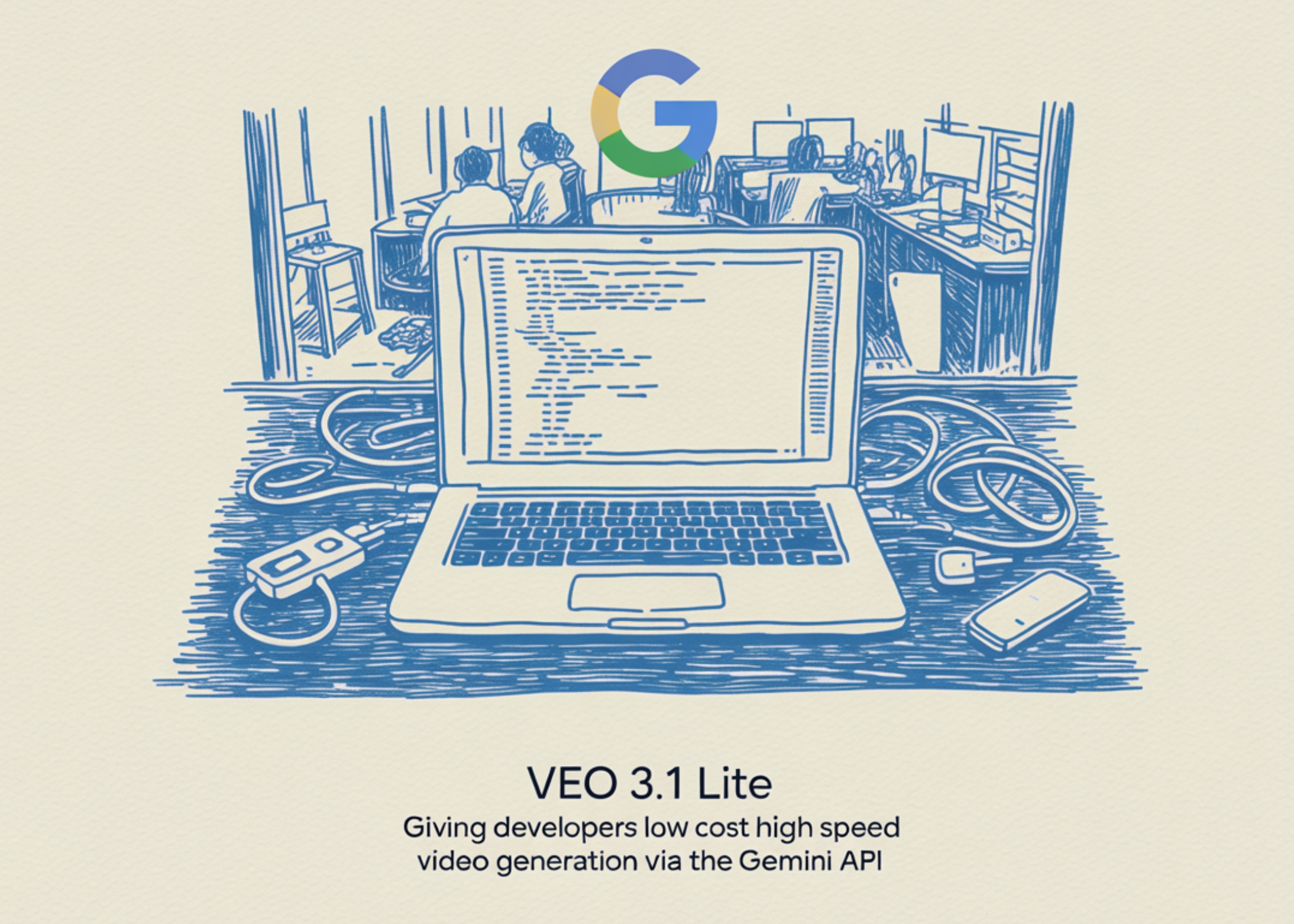
Pricing alone doesn't tell the full story. Here's how Veo 3.1 Lite stacks up against the current API landscape:
| Model | Cost/sec (approx.) | Max Resolution | Max Duration | Audio | API Access |
|---|---|---|---|---|---|
| Veo 3.1 Lite | $0.05 | 1080p | 8s | Ambient | Gemini API |
| Veo 3.1 Fast | $0.10 | 4K | 8s | Full | Gemini API |
| Kling 3.0 | $0.10–0.15 | 4K | 10s | Yes | Kling API |
| Seedance 1.5 Pro | $0.05 | 1080p | 8s | No | FAL.AI |
| Runway Gen-4.5 | $0.10–0.20 | 4K | 10s | No | Runway API |
| Wan 2.6 | $0.05 | 720p | 5s | No | Various |
| Sora 2 API | — | — | — | — | Discontinued |
Key Takeaways From This Comparison
Veo 3.1 Lite ties Seedance 1.5 Pro and Wan 2.6 as the cheapest options at roughly $0.05 per second. But Veo 3.1 Lite has two advantages: it supports 1080p (Wan caps at 720p) and it includes native audio generation (neither Seedance nor Wan do).
Kling 3.0 remains the best value at the mid-tier. At $0.10–0.15 per second you get 4K output, 10-second clips, and audio. For teams that need maximum quality per clip, Kling delivers roughly 80–90% of Veo 3.1's quality at a fraction of the cost.
Runway Gen-4.5 is the premium option with the most mature creative tooling, but the highest per-clip cost for API access.
Sora is gone. If you were using the Sora 2 API, you need to migrate now. Veo 3.1 Lite is the most direct replacement — similar quality tier, lower cost, and Google isn't going anywhere. For a full breakdown of Sora alternatives, see our analysis of the Sora 2 shutdown.
Why Google Launched This Now
The timing of Veo 3.1 Lite is not a coincidence. Three market forces converged to make this launch strategically essential for Google.
1. The Sora Vacuum
OpenAI shut down Sora on March 24, 2026 — exactly one week before Veo 3.1 Lite launched. Sora was reportedly burning $15 million per day in GPU costs and generated just $2.1 million in total revenue. The API, the app, and the web experience are all gone.
For every developer and creative team that built workflows on Sora's API, there's now a forced migration. Google positioned Veo 3.1 Lite as the landing pad: lower cost than Sora ever was, same generation speed as its premium tier, and backed by infrastructure that isn't going anywhere.
2. The Chinese Model Price War
ByteDance's Seedance 2.0, Kuaishou's Kling, and Tencent's open-source Hunyuan Video have been aggressively undercutting Western providers on price. Kling 3.0 delivers near-premium quality at mid-tier prices. Hunyuan Video is literally free.
Google needed a response at the developer tier. Veo 3.1 Lite at $0.05/sec matches the cheapest Chinese competitors while keeping developers inside Google's ecosystem — Gemini API, Cloud billing, Vertex AI tooling.
3. The Volume Play
AI video is transitioning from "one impressive demo clip" to "thousands of clips in a production pipeline." E-commerce product videos, social ad variations, localized content — these use cases need cheap, fast, reliable generation at volume. The full Veo 3.1 at $0.40/sec was too expensive for this. Lite is priced for it.

Who Should Use Veo 3.1 Lite (And Who Shouldn't)
Ideal Use Cases
- Ad creative teams generating dozens of variations for A/B testing across platforms
- E-commerce platforms that need automated product videos from catalog images (image-to-video)
- Social media managers producing high-volume short-form content in portrait and landscape
- Developers building video generation features into SaaS products where per-unit cost matters
- Agencies prototyping concepts before investing in higher-quality renders
When to Use a Different Model
- Broadcast or cinema production — you need 4K; use Veo 3.1 Full or Kling 3.0
- Long-form content — 8 seconds max is a hard limit; Kling supports 10s, and dedicated video editors handle longer sequences
- Dialogue-heavy scenes — Lite's audio is ambient only; use Full Veo 3.1 for speech
- Iterative editing workflows — no video extension means you can't build on a generated clip
Quality differences between Veo 3.1 Lite and Veo 3.1 Fast are less pronounced than you might expect. Early testing shows that the gap between Lite and Fast is smaller than the gap between Fast and the full Veo 3.1. For most web and social applications, Lite output is visually indistinguishable from Fast.
How to Get Started With the Veo 3.1 Lite API
Integration is straightforward if you're already in the Gemini API ecosystem:
- Access: Available through the Gemini API paid tier and Google AI Studio
- Model ID:
veo-3.1-lite-generate-preview - Input: Text prompts (up to 1,024 tokens) or image + text for image-to-video
- Output: One video per request, with configurable duration (4s, 6s, 8s) and resolution (720p, 1080p)
- Billing: Per-second pricing based on resolution — $0.05 (720p) or $0.08 (1080p)
For teams already using XainFlow, Veo 3.1 Lite and Veo 3.1 Fast are both available through our AI Suite, which lets you switch between models — including Kling, Seedance, and others — without changing your workflow. This is especially useful for comparing output quality across models before committing to a production pipeline.
For a deeper look at building API-driven content pipelines, check out our step-by-step guide to AI-first content production.
What This Means for Creative Teams in 2026
The AI video API market just crossed an inflection point. When a major provider like Google prices video generation at five cents per second, it signals that AI video is no longer a premium experiment — it's infrastructure.
Three implications for creative teams:
1. Budget ceilings are gone for prototyping. At $0.40 per 8-second clip, teams can iterate on concepts without worrying about burning through credits. Generate 50 variations of an ad concept for the price of a coffee.
2. The API tier matters more than the consumer tier. Sora failed as a consumer app but the API had real production value. Google learned from this: Veo 3.1 Lite is developer-first, with no social feed, no consumer app — just a clean API endpoint.
3. Multi-model workflows are now standard. No single model wins every use case. The smart approach is using Lite for high-volume iteration, Fast for hero content, and Full for premium deliverables. Platforms that let you switch between models seamlessly — like the approach described in our definitive comparison of AI video generators — will become essential tooling.
"The best AI video model is the one that matches your cost-quality-speed requirements for each specific use case. One model can't do everything."
The Bottom Line
Veo 3.1 Lite is the right model at the right time. It won't replace the full Veo 3.1 for premium work, and it won't out-quality Kling 3.0 at the mid-tier. But it will make AI video generation accessible to every developer and creative team that was previously priced out — or left stranded by Sora's shutdown.
At $0.05 per second, the question is no longer "can we afford to use AI video in our pipeline?" It's "how many clips should we be generating?"
Explore how AI video models compare across quality, cost, and features in our complete 2026 video generator comparison.