Best AI Video Generators in 2026: The Definitive Guide
If you're searching for the best AI video generator in 2026, the honest answer is: it depends on what you're making. The landscape has exploded. Six months ago, most AI video models produced wobbly, six-second clips that looked like fever dreams. Today, tools like Sora 2, Kling 3.0, Runway Gen-4.5, and Veo 3.1 generate cinematic-quality footage with synchronized audio, consistent characters, and real-world physics.
The problem isn't finding a good AI video generator — it's choosing the right one for your workflow. Each model has distinct strengths, pricing structures, and creative tradeoffs that matter enormously depending on whether you're producing social content, brand campaigns, or narrative films.
We tested the six most relevant models head-to-head across real production scenarios. This guide breaks down what actually matters: output quality, cost per second, audio capabilities, and how each tool fits into a professional creative pipeline.
The 2026 AI Video Generation Landscape
The AI video generation market has matured dramatically. Native audio generation, multi-shot sequences, and physics-aware rendering are no longer experimental features — they're baseline expectations. Here's what defines each tier:
Tier 1 — Cinematic Production: Runway Gen-4.5, Sora 2, and Veo 3.1 compete for the highest visual fidelity, with each excelling in different dimensions of quality.
Tier 2 — Production Workhorses: Kling 2.6 Pro and Hailuo 2.3 deliver excellent quality at significantly lower costs, making them ideal for high-volume content pipelines.
Tier 3 — Budget & Speed: Wan 2.6 and LTX 2.0 prioritize affordability and generation speed, serving teams that need quantity without breaking the bank.
"The best AI video generator isn't the most expensive one — it's the one that fits your production pipeline and budget."
The real question for creative teams isn't "which model is best?" — it's "which combination of models covers all my use cases?"
Head-to-Head Comparison: Sora 2 vs Kling 3.0 vs Runway Gen-4.5 vs Veo 3.1
Here's how the top four models stack up across the metrics that matter most for professional video production:
| Feature | Sora 2 | Kling 3.0 | Runway Gen-4.5 | Veo 3.1 |
|---|---|---|---|---|
| Max Resolution | 1080p | 4K native | 4K | 1080p |
| Max Duration | 20 sec | 15 sec (ext. 3 min) | 10 sec | 8 sec |
| Native Audio | Yes | Yes (6 languages) | No | Yes |
| Physics Engine | Strong | Excellent | Best-in-class | Strong |
| Cost per Second | ~$0.15 | ~$0.10 | ~$0.25 (Gen-4.5) | ~$0.20 |
| Character Consistency | Good | Excellent (Director Memory) | Good | Good |
| Multi-Shot Support | Limited | Yes (native) | Via workflows | No |
| Best For | Narrative & storytelling | Volume production | Artistic control | Dialogue & lip-sync |
Pricing shown reflects per-second generation costs on paid plans. Actual costs vary by resolution, plan tier, and whether audio is included. All prices current as of February 2026.
Runway Gen-4.5: The Filmmaker's Choice
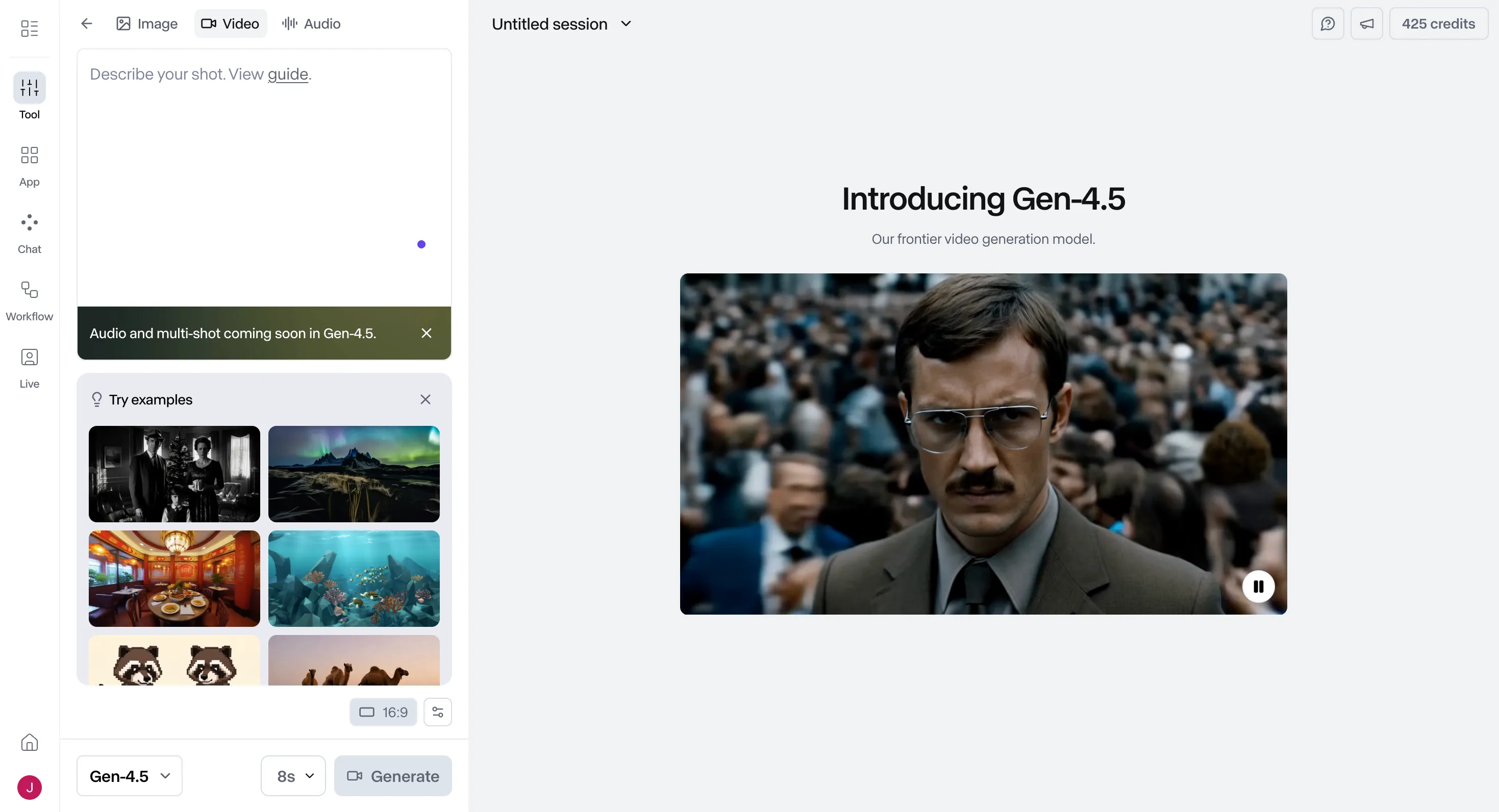
Runway Gen-4.5 currently holds the #1 position on the Artificial Analysis Text-to-Video leaderboard with a 1,247 Elo score — surpassing every competitor including Google and OpenAI. That ranking isn't just hype. Gen-4.5's breakthrough is physical realism: weight, inertia, liquids, cloth, and collisions behave like real-world objects.
Why choose Runway:
- Unmatched physics simulation — fabric drapes naturally, liquids flow correctly, objects have believable weight
- Granular creative control over camera movements, lighting, and composition
- Strong ecosystem with API access for pipeline integration
- Plans from $12/month (Standard) to $76/month (Unlimited with Explore Mode)
The tradeoff: Gen-4.5 costs 25 credits per second — 5x more than Gen-4 Turbo. No native audio generation means you'll need a separate sound design step. And at 10-second max duration, longer sequences require stitching multiple generations.
For creative directors who need precise artistic control over every frame, Runway remains the gold standard. But that precision comes at a premium.
Sora 2: The Storyteller's Engine
OpenAI's Sora 2 excels where other models struggle: narrative coherence. While competitors produce beautiful isolated clips, Sora 2 generates video with emotional depth, dialogue-driven scenes, and storytelling logic that feels intentional rather than random.
Why choose Sora:
- Best prompt adherence — complex, multi-element scenes render as described
- Native synchronized audio including dialogue, ambient sounds, and music
- Strong understanding of spatial relationships and cause-and-effect
- Included with ChatGPT Plus ($20/month) for up to 50 videos at 480p
The tradeoff: Locked inside the OpenAI ecosystem. No standalone API for custom pipelines (yet). Free tier was removed in January 2026. Resolution caps at 1080p, and the Plus plan limits you to 480p — you need Pro ($200/month) for full-resolution output.
Sora 2 is the most "creatively intelligent" model available. If your production involves characters telling stories, delivering dialogue, or interacting emotionally, nothing else comes close.
Kling 3.0: The Volume Production Powerhouse
Kling 3.0, launched February 5, 2026, is the workhorse model for teams producing content at scale. Its standout feature is multi-shot storyboarding: generate 3-15 second sequences with consistent characters across different camera angles — something no other model handles natively.
Why choose Kling:
- Native 4K resolution at competitive pricing (~$0.10/sec)
- "Director Memory" keeps characters consistent across multiple generations
- Physics-aware engine handles complex interactions (hugging, fighting, machinery)
- Native audio in 6 languages with accent control and multi-character dialogue
- Free tier with 66 daily credits — best free option for testing
The tradeoff: While Kling 3.0 is technically impressive, it's still in early access (Ultra subscribers only). The 2.6 Pro model ($0.07/sec) is the more battle-tested option for production work right now.
For agencies producing social media content, ad variations, or serialized video content, Kling's combination of consistency, speed, and cost-efficiency is hard to beat.
"Kling 3.0's Director Memory is the first AI video feature that genuinely solves the character consistency problem for multi-shot production."
Veo 3.1: The Dialogue Specialist
Google's Veo 3.1 wins one category decisively: lip synchronization and character dialogue. Where other models generate audio that roughly matches visual movement, Veo 3.1 produces natural lip-sync and lifelike body language that makes AI-generated characters look like they're actually speaking.
Why choose Veo:
- Best-in-class lip-sync and facial expression rendering
- Full sound design generated natively (effects, ambient, dialogue)
- SynthID watermarking for content authenticity and compliance
- Strong cinematic control with camera angle and lighting options
- Available through Google Cloud Vertex AI API
The tradeoff: Limited to 8-second clips — the shortest of the top-tier models. At $0.20/sec, it's also the most expensive per second. No consumer-facing app; access is through API or Google AI Studio.
If your use case involves talking-head content, explainer videos, or any scenario where characters need to speak convincingly, Veo 3.1 is the clear winner.
The Budget Contenders: Wan 2.6 and Hailuo 2.3
Not every project needs a $0.20/second model. Two models stand out for teams prioritizing volume and cost-efficiency:
Wan 2.6 — The Price Leader
At approximately $0.05 per second, Wan 2.6 is the most affordable AI video generator in the market. It generates 1080p content quickly and reliably. The quality won't match Runway or Sora for cinematic work, but for social media clips, product demos, and internal content, the cost savings are massive.
Hailuo 2.3 — The Style Chameleon
MiniMax's Hailuo 2.3 excels at stylization. It supports anime, illustration, ink wash painting, game CG, and other artistic styles that the "realism-focused" models struggle with. The Media Agent feature handles everything from model selection to editing in a single pipeline, and Hailuo 2.3 claims a new global record for video model cost-effectiveness.
For high-volume social content, consider using Wan 2.6 or Hailuo 2.3 for your first drafts, then upscale your best performers with Runway or Kling for final production. This hybrid approach can cut costs by 60-70% without sacrificing quality on your hero content.
Which AI Video Generator Should You Choose?
Skip the feature comparison tables. Here's the decision framework based on what you're actually producing:
Producing narrative films or branded storytelling? → Sora 2. Nothing matches its narrative intelligence and emotional coherence.
Need maximum artistic control and physical realism? → Runway Gen-4.5. The precision and physics engine are unmatched, and the filmmaker community is the strongest.
Running a content pipeline at scale (social, ads, series)? → Kling 3.0 / 2.6 Pro. Multi-shot consistency + competitive pricing = the production workhorse.
Creating talking-head or dialogue-driven content? → Veo 3.1. Lip-sync quality that no competitor can touch.
Maximizing volume on a tight budget? → Wan 2.6 for realistic content, Hailuo 2.3 for stylized or animated content.
Want all of them in one workflow? → XainFlow. Connect multiple AI video generators into a single production pipeline. Route each shot to the model that handles it best — narrative scenes to Sora, dialogue to Veo, volume content to Kling — without switching between six different platforms. One workflow, every model, zero context-switching.
The Future: Multi-Model Workflows
The creators getting the best results in 2026 aren't loyal to a single model. They're building multi-model workflows that route each shot to the generator that handles it best. A brand film might use Sora 2 for the hero narrative sequence, Kling 3.0 for consistent product shots across angles, Veo 3.1 for a spokesperson dialogue segment, and Wan 2.6 for B-roll filler.
This modular approach is where AI video production is heading — and it's exactly why workflow orchestration platforms matter more than any individual model. The winners in this space won't be the teams with the best single tool, but the ones who build the smartest pipeline across all of them.
The AI video generator war is far from over. New models ship monthly, pricing drops quarterly, and what was impossible last year is now commodity. The only constant? The team with the most adaptable workflow wins.