Agentic Creative Platforms Are Here: Firefly and Claude
An agentic creative platform is no longer a future category. Adobe made Firefly AI Assistant available in public beta on April 27, 2026, and Anthropic followed with Claude for Creative Work on April 28. Together, those launches show where the market is moving: away from isolated AI generators and toward systems that can plan, execute, and revise multi-step creative workflows across tools, models, and assets.
For creative teams, the important question is practical: how do you turn that new agentic interface into a repeatable production process? Adobe offers one path inside Creative Cloud. Anthropic shows another path through connectors into tools like Adobe, Blender, Ableton, Fusion, SketchUp, and Splice. XainFlow is built for the workflow path: orchestrating generation, automation, brand assets, video, images, review, and delivery without locking the full process into one editing suite.
The right takeaway is not "Adobe launched a competitor." The right takeaway is that agentic creative platforms are becoming the default interface for production work.
What Is an Agentic Creative Platform?
An agentic creative platform is software that can turn a creative goal into a sequence of actions. Instead of asking one model for one asset, the user describes the outcome and the system chooses or coordinates the steps required to get there.
For a creative team, that can mean:
- Turning a product image into a full set of campaign variants.
- Generating still assets, then adapting them into short video.
- Applying brand rules across images, copy, crops, and exports.
- Routing outputs through review before delivery.
- Reusing assets, prompts, models, and project context across multiple jobs.
The defining feature is orchestration. A text-to-image model creates an image. A video model creates a clip. An agentic creative platform coordinates the workflow around those outputs: source inputs, generate variants, apply constraints, improve assets, format deliverables, preserve context, and keep the human in control.
That is why the latest launches from Adobe and Anthropic matter. They are not only new features. They are signals that the creative software market is moving from "which model is best?" to "which system can run the work?"
The next battle in AI creativity is not only model quality. It is workflow control.
Why Firefly AI Assistant Matters
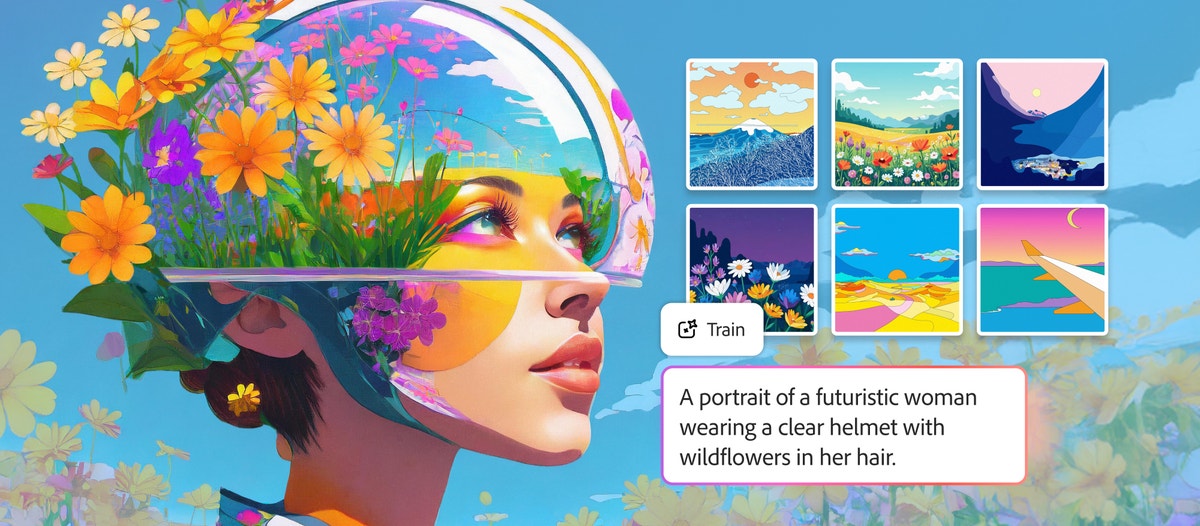
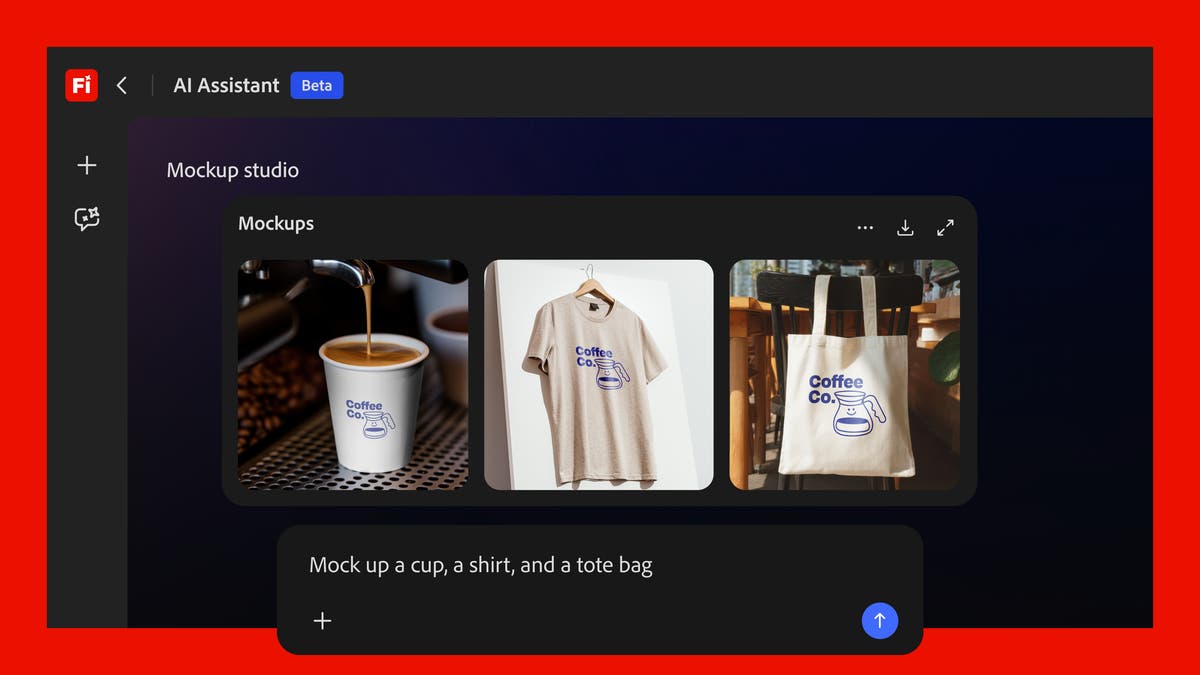
Adobe's Firefly AI Assistant public beta is the clearest mainstream example so far. Adobe says users can describe what they want in a conversational interface, then have the assistant orchestrate workflows across Creative Cloud apps including Photoshop, Lightroom, Premiere, Firefly, Illustrator, and more.
The public beta includes several pieces that define the agentic creative platform pattern:
| Capability | Why It Matters |
|---|---|
| Conversational interface | The user describes the outcome instead of manually mapping every tool step. |
| Creative Skills | Repeatable workflows can be launched from a single instruction. |
| Pro-grade tool access | The assistant can draw from Adobe tools like Generative Fill, Remove Background, Vectorize, Auto Tone, and presets. |
| Human control | Adobe emphasizes that creators can see steps, answer questions, refine outputs, redirect, or take over. |
| Cross-app persistence | Assets can be saved to Creative Cloud and continued inside Adobe apps. |
Adobe's April 15 announcement framed this as a shift into "agentic creativity" and said Firefly would combine Creative Cloud apps, generative AI models, and pro-grade editing tools in one interface. The April 27 beta moved that from positioning to availability for Creative Cloud Pro and paid Firefly plans.
For agencies, the important part is not the brand name. It is the workflow shape: outcome first, toolchain second.
Claude Connectors Confirm the Bigger Shift
The Adobe launch became more interesting one day later, when Adobe announced Adobe for creativity in Claude. That connector brings more than 50 Adobe tools into Claude, including Photoshop, Illustrator, Firefly, Express, Premiere, Lightroom, InDesign, and Stock.
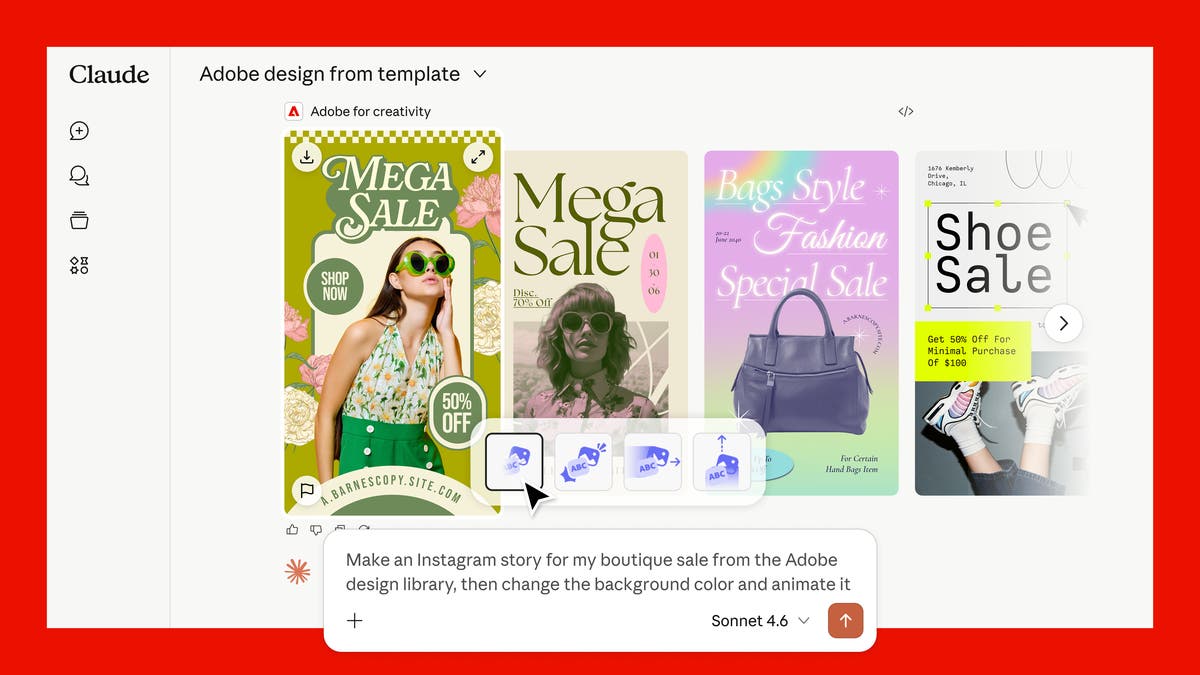
Anthropic's own Claude for Creative Work announcement broadened the pattern even further. Claude added connectors for creative tools including Adobe, Blender, Ableton, Affinity by Canva, Autodesk Fusion, Resolume, SketchUp, and Splice. The stated goal was not to replace taste or imagination, but to help with ideation, tool learning, pipeline handoff, repetitive production work, and multi-step creative tasks.
That matters because it shows two competing ideas emerging at once:
| Approach | Example | Strength | Limitation |
|---|---|---|---|
| Suite-native agent | Firefly AI Assistant | Deep control inside one professional ecosystem | Best when the team already lives inside that suite |
| Connector-based assistant | Claude for Creative Work | Can reach many tools through connectors | Depends on connector quality and app permissions |
| Workflow-native platform | XainFlow | Designed around creative pipelines, model orchestration, and repeatable production | Best when the team needs workflow control across models, assets, and review steps |
The useful lesson is that creative tools are becoming more connected. Teams still need specialist apps, but they also need a workflow layer that keeps the full production process visible, repeatable, and easy to improve.
From AI Tools to AI Workflows
The first wave of generative AI was model-centric. Teams asked: Which image model is best? Which video model has better motion? Which tool is cheaper? That is still useful, and we track it in guides like our best AI image generators comparison and best AI video generators comparison.
But production teams eventually hit a different problem. A model can make an asset. It does not automatically make the workflow.
The workflow usually includes:
- Brief interpretation.
- Brand or campaign context.
- Model selection.
- Prompting and generation.
- Variation management.
- Image or video enhancement.
- Human review.
- Formatting for channels.
- Export and delivery.
- Reuse of what worked.
That is why agentic creative platforms are becoming important. They reduce the manual overhead between steps. They also create a cleaner place to encode team knowledge: approved references, prompts, model choices, review logic, project context, and recurring production patterns.
The best early use cases for agentic creative platforms are not "make everything." They are repetitive creative operations with clear inputs, constraints, and review criteria.
Where XainFlow Fits in the Agentic Creative Stack
Firefly AI Assistant is a strong example of a suite-native creative agent. If a team already lives in Photoshop, Premiere, Lightroom, Illustrator, and Express, Adobe can reduce tool switching and automate familiar production steps inside that ecosystem.
XainFlow approaches the same shift from the workflow layer. It is built for teams that need to coordinate models, assets, approvals, and production stages across the creative stack. That matters when a team wants to:
- Combine image, video, and automation steps in one pipeline.
- Compare or chain multiple AI models instead of depending on one vendor.
- Turn repeatable creative processes into reusable workflows.
- Use a workflow canvas to make production logic visible.
- Connect creative generation to team operations, API usage, and MCP-enabled automation.
- Preserve human approval while reducing repetitive execution.
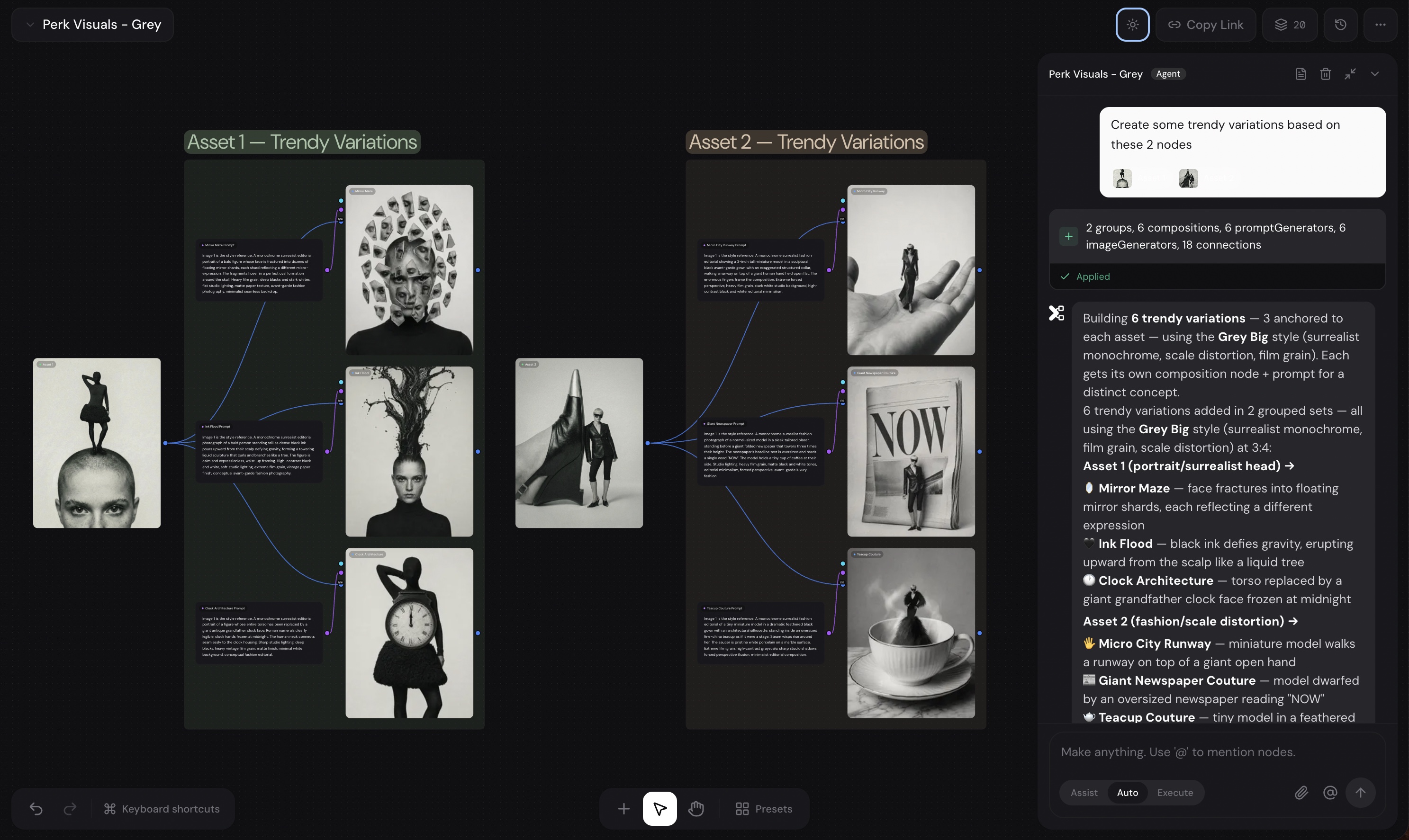
This is not an either/or decision. Creative teams will keep using specialized tools for editing, design, 3D, audio, and delivery. The strategic question is where the workflow brain lives.
For some teams, it lives inside one suite. For others, it needs to live above the toolchain.
A Practical Evaluation Framework for Creative Teams
Creative teams should evaluate agentic creative platforms with production criteria, not hype. The right question is not "does it have an AI assistant?" The right question is "can it reliably move work from brief to deliverable with less manual overhead?"
Use this checklist:
| Evaluation Area | Questions to Ask |
|---|---|
| Workflow depth | Can the system handle multi-step processes, or only one-off prompts? |
| Model flexibility | Can the team choose the best model for each step? |
| Brand control | Can brand references, rules, and examples be reused? |
| Human review | Can people inspect, redirect, approve, or reject outputs? |
| Asset memory | Does the system preserve project context and prior assets? |
| Export paths | Can outputs move into the tools and channels the team already uses? |
| Automation | Can recurring tasks become reusable workflows or API-driven pipelines? |
| Cost visibility | Can the team estimate and manage generation costs across steps? |
The most valuable platforms will make workflows inspectable. Creative teams do not want black boxes for production. They want speed, but they also need accountability, versioning, brand consistency, and control.
That is the practical opening for XainFlow: agentic creative workflows that are visible, reusable, and built around production rather than novelty.
Risks and Limits of Agentic Creative Platforms
Agentic creative platforms will not remove the hard parts of creative work. They shift where the hard parts happen.
The risks are real:
- Generic taste: Agents can execute, but they still need strong direction.
- Workflow opacity: If teams cannot inspect steps, they cannot trust outputs.
- Brand drift: Automated variants can slowly move away from a brand system.
- Permission sprawl: Connectors need access to tools and assets, which raises governance questions.
- Cost creep: Multi-step generation can become expensive when every variation triggers more model calls.
- Over-automation: Not every creative decision should become a workflow.
The solution is not to avoid agentic systems. The solution is to design them with clear human checkpoints.
A strong agentic creative platform should make the human more strategic, not less involved. The platform should handle setup, repetition, formatting, and handoff while the team owns taste, strategy, and approval.
Build the Workflow, Not Just the Asset
Firefly AI Assistant and Claude for Creative Work are useful signals because they show where creative production is going: teams do not just need better generators, they need systems that can carry work from brief to finished asset with fewer manual handoffs.
The practical next step is to test one repeatable workflow. Start with a campaign brief, generate a set of image directions, select the strongest option, turn it into short-form video, route variants for review, and export the final assets for each channel. That is where agentic creative platforms become valuable: they make the production path visible, repeatable, and easier to improve.
XainFlow is built for that kind of work. Create a visual workflow, choose the image and video models you want to use, connect the steps, keep approvals in the loop, and reuse the process the next time a similar brief arrives.
Frequently Asked Questions
What is an agentic creative platform?
An agentic creative platform is a system that can plan and execute multi-step creative workflows across models, tools, assets, and review steps while keeping humans in control of direction and approval. It is different from a single AI generator because it coordinates the production process, not just one output.
Is Firefly AI Assistant a competitor to XainFlow?
Firefly AI Assistant helps teams automate work inside Adobe Creative Cloud. XainFlow helps teams build repeatable creative workflows across models, assets, approvals, and production steps. A team can use specialist tools like Adobe and still use XainFlow to coordinate the broader production pipeline.
Why should creative teams care about Adobe and Claude's announcements?
Because they show that creative AI is moving from one-off generation toward workflow orchestration. The important question for teams is how to turn that shift into a production process they can repeat, review, and scale.
Do agentic creative platforms replace creative teams?
No. The strongest systems automate repetitive execution while leaving taste, strategy, judgment, and final approval with humans. The practical shift is from manual production labor toward creative direction and workflow design.