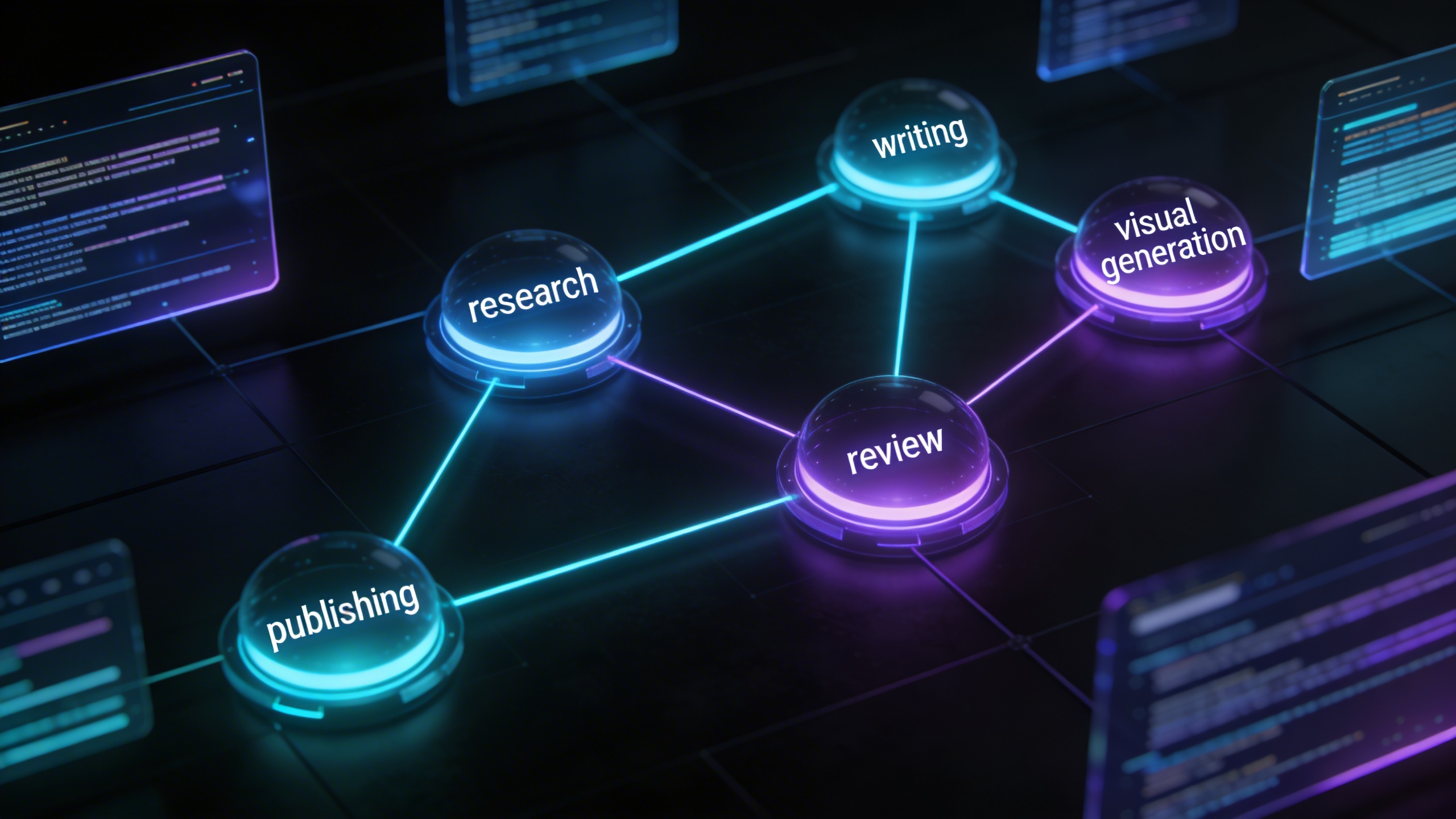
If you manage a creative team in 2026, you've probably noticed something: the job title hasn't changed, but the job itself has become unrecognizable. What used to be "traffic management" — routing briefs, chasing approvals, updating spreadsheets — has quietly evolved into something far more strategic. Creative operations is no longer about keeping the trains running. It's about building the railway.
The numbers tell the story. The workflow automation market hit $23.8 billion in 2025 and is racing toward $40.8 billion by 2031. The creative management platform market is growing even faster, projected to reach $4.8 billion by 2033 at a 19.5% compound growth rate. Studios that once managed 10–20 creatives are now coordinating 30–100, and the old tools — email threads, shared drives, Monday standup meetings — simply can't scale.
What's emerging in their place is something we might call a Creative Operating System: an AI-powered infrastructure that handles the operational complexity of modern creative production while freeing human talent to do what it does best — create.
The 60/27/13 Problem

Here's a statistic that should make every creative director uncomfortable: according to Asana's Anatomy of Work research, knowledge workers spend 60% of their day on coordination — communicating about work, chasing status updates, switching between apps, searching for information. Only 27% goes to the skilled work they were hired for. A mere 13% is spent on strategic thinking.
For creative teams, this imbalance is particularly painful. Every hour a designer spends updating a project tracker is an hour not spent designing. Every afternoon a producer loses to approval chains is an afternoon of production capacity evaporated.
The traditional Creative Ops response was to hire more coordinators — project managers, traffic managers, producers. But adding humans to a coordination problem just creates more coordination. What creative teams actually need is a system that makes coordination automatic, so human attention can flow to creative and strategic work.
"The most expensive part of creative production isn't the creation — it's the coordination. And coordination is exactly what AI was built to handle."
This is the fundamental insight driving the Creative Ops transformation. The discipline isn't just evolving — it's being rebuilt from the ground up around a different assumption: that machines should handle the operational complexity, and humans should handle the creative complexity.
From Support Function to Strategic Driver
Creative Operations has gone through three distinct phases, and understanding this trajectory explains where the industry is headed.
Phase 1 — Traffic Management (Pre-2020): Creative Ops was primarily a logistics function. Traffic managers routed jobs, tracked deadlines, and managed physical or digital asset handoffs. The tools were spreadsheets, email, and shared network drives. The role was reactive: solve bottlenecks as they appear.
Phase 2 — Workflow Coordination (2020–2024): Platforms like Monday.com, Asana, and Wrike brought structure to creative workflows. Teams could visualize pipelines, automate notifications, and track utilization. Creative Ops became proactive — designing processes, not just managing them. But the core limitation remained: a human still orchestrated every decision, every handoff, every exception.
Phase 3 — AI-Powered Operating System (2025–Present): This is where things get interesting. Creative Ops is becoming an intelligent system layer that sits between human creativity and market demands. AI agents handle resource allocation, brief analysis, quality checks, and performance optimization. The human role shifts from orchestration to governance — setting the rules, defining the standards, and making the judgment calls that require taste and context.
| Phase | Focus | Role of Technology | Human Value |
|---|---|---|---|
| Traffic Management | Job routing | Spreadsheets, email | Logistics coordination |
| Workflow Coordination | Process design | PM platforms, DAMs | Process optimization |
| AI Operating System | Strategic intelligence | AI agents, automation | Creative governance |
Screendragon's 2025 Creative Operations research found that studios are scaling from 10–20 to 30–100 team members — a growth rate that makes manual coordination physically impossible. The shift to AI-powered operations isn't a preference; it's a necessity.
The Creative Flywheel

The most sophisticated Creative Ops teams in 2026 are building what industry leaders call the "Creative Flywheel" — a continuous, data-driven loop that connects creation to outcomes and feeds insights back into future production.
Here's how it works:
Create
AI-powered tools generate content at scale — images, video, copy, layouts — while maintaining brand consistency through loaded guidelines and style systems. A single brief can spawn dozens of variations across formats and channels simultaneously.
Distribute
Automated publishing agents schedule and deploy content across platforms, adapting formats, dimensions, and messaging for each channel. What once required a media coordinator managing a spreadsheet now happens through API integrations and intelligent routing.
Analyze
Performance data flows back in real time. Creative Ops teams can see not just how many assets were produced, but which ones performed, where they were used, and what engagement patterns emerged. This is the shift from utilization tracking to asset intelligence.
Optimize
Here's where the flywheel accelerates: analytics insights feed directly into the next creative cycle. Underperforming assets get flagged for refresh. Winning creative patterns get amplified. Budget allocation shifts based on actual performance data, not gut instinct.
The teams that close this loop — connecting creative output to business outcomes and feeding those insights back into production — are seeing dramatic improvements. Research shows that teams with full connectivity between content and digital assets are 4x more likely to report significant improvements in content ROI.
"Creative Ops leaders are no longer asking 'Can we produce this?' They're asking 'Is this being used, where, and by whom?'"
Agentic AI Enters the Creative Stack
The term "agentic AI" — autonomous AI systems that can plan, execute, and adapt without step-by-step human instruction — is reshaping Creative Ops in three critical ways.
Intelligent Resource Allocation
AI agents analyze team capacity, skill profiles, project requirements, and historical performance to match the right people (and tools) to the right tasks. Instead of a producer manually checking availability across six time zones and twenty-three team members, an agent surfaces the optimal assignment in seconds.
Automated Quality and Compliance
Brand compliance, format specifications, platform requirements, accessibility standards — these are rule-based checks that consume enormous human time and attention. AI agents now handle them continuously, flagging exceptions for human review rather than requiring humans to manually check every output.
Predictive Production Planning
Perhaps the most transformative capability: AI agents that can forecast production needs based on campaign calendars, historical patterns, and market signals. Instead of reactive capacity planning ("we need five more designers next month"), teams get proactive intelligence ("based on Q3 campaign briefs and current pipeline velocity, we'll need additional motion design capacity starting week 34").
Start your agentic AI implementation with the coordination layer, not the creative layer. Automate brief intake, resource matching, and quality checks first. These deliver immediate ROI and build the infrastructure for more advanced creative AI capabilities later.
The practical impact is significant. According to McKinsey, generative AI can increase task throughput by 66% on average, and employees using AI tools report a 29% productivity increase. But the real gains come not from individual task acceleration — they come from eliminating the coordination overhead that consumes most of the creative day.
What This Means for Creative Teams

The rise of Creative Ops as an AI-powered operating system doesn't eliminate creative jobs. It transforms them. Here's what's changing:
Creative Directors move from reviewing individual assets to defining creative frameworks and governance rules that AI agents follow. Their taste and judgment become encoded into systems that scale.
Producers and Project Managers shift from manual coordination to system design and exception handling. They build and refine the workflows rather than executing them step by step.
Designers and Creators spend more time on conceptual work, strategic thinking, and the uniquely human aspects of creativity — storytelling, emotional resonance, cultural context — while AI handles variation, formatting, and distribution.
Creative Ops Leaders become the architects of the entire system: selecting tools, designing agent workflows, defining measurement frameworks, and ensuring that automation amplifies quality rather than diluting it.
The data supports this shift. 84% of users say AI helps them be more creative, and 89% of workers report greater job fulfillment after automation of routine tasks. When the operational burden lifts, the creative work actually gets better.
Building a Creative Operating System
The transition from traditional workflow coordination to an AI-powered Creative OS doesn't happen overnight, but teams that start now will have a structural advantage that compounds over time.
The principles are straightforward: automate coordination before creation. Build connected systems, not faster islands. Keep humans at the strategic gates. Measure outcomes, not activities. And invest in the context infrastructure — brand guidelines, performance data, creative knowledge bases — that makes AI agents genuinely useful rather than generically fast.
The creative teams that thrive in 2026 and beyond won't be the ones with the most AI tools. They'll be the ones who've built the most intelligent operating system around their creative process — one where AI handles the complexity of coordination, and humans focus on the complexity of creation.
That's not a prediction. For the teams already running this way, it's Tuesday.