
How Small Teams Are Outproducing Big Agencies with AI
Three-person creative studios are producing 5× more content than 20-person agencies — without sacrificing quality. The math no longer works in favor of scale. A lean team running the right AI stack is routinely delivering work that would have required a full agency two years ago: faster, cheaper, and often at higher quality. This is not a prediction. It's happening right now, across video production, social content, and full campaign execution.
Here's what the data shows, how these teams structure their workflows, and what every creative team can learn from them.
Why the Big Agency Model Is Breaking Down
Traditional agencies built their value proposition around headcount. Larger teams meant more bandwidth, faster turnarounds, and the ability to handle multiple clients simultaneously. That model created predictable margins — but also predictable overhead: account managers, project managers, and layers of review between brief and delivery.
AI has eliminated most of that justification. The tasks that consumed 60–70% of production time — research, first drafts, image generation, video editing, formatting, and scheduling — are now largely automatable. Smaller, nimbler teams are capturing that efficiency faster than their larger counterparts.
According to Envato's State of AI in Creative Work 2026 report, new organizational models are emerging: one-person studios outcompeting traditional agencies through AI-powered scalability, and decentralized remote-first teams accelerating output through cloud-based AI workflows.
The structural advantage of size has become a liability. Big agencies carry overhead that lean teams simply don't need.
Three Teams That Prove the Model
Rather than abstract claims, here are three documented scenarios showing exactly how small teams are structuring their AI-augmented operations.
The 3-Person Video Studio
A three-person video production team — one creative director, one editor, one strategist — adopted a full AI workflow for a regional retail client. Before AI, they could produce four campaign videos per quarter. After integrating AI video generation, script automation, and automated asset management, their output reached eighteen campaign-grade videos per quarter at the same cost.
The key shift: they stopped treating AI as a finishing tool and started using it at the beginning of every project — ideation, scripting, storyboarding, and even rough cuts. Human effort was redirected to the 30% of production where judgment is irreplaceable: creative direction, final review, and client relationships.
The client saw no reduction in quality. They saw an increase in speed.
The 1-Person Content Strategist
A mid-sized SaaS company replaced a five-person content team with one senior content strategist and an AI writing and distribution stack. Output went from 12 articles per month to 60 — a 5× increase. Organic traffic doubled within four months.
The strategist's role changed fundamentally: less writing, more directing. Every piece started with AI-generated research, keyword analysis, and an outline. The strategist reviewed, refined, and applied brand voice to a near-complete first draft in minutes rather than hours. Images were AI-generated in-platform rather than sourced from stock libraries.
Total labor cost per article dropped by 78%. Quality — measured by time on page and organic rankings — improved.
The 2-Person Creative Agency
Two people. Clients that previously required eight-person teams to service. A 72-hour video ad production cycle for $2,000 that competing agencies were quoting at $28,000 and six weeks of lead time.
The workflow: brief intake → AI image generation for storyboard → AI video generation for rough edit → human refinement → client delivery. The two founders handled client relationships, creative decisions, and quality control. AI handled execution.
Their pricing is not cheaper than the large agencies they compete with. It's the same. The margin difference is entirely captured by the team.
"The agencies succeeding in 2026 aren't the biggest. They're the ones who figured out that AI doesn't replace creative thinking — it removes everything that was getting in the way of it."
How the AI-Augmented Workflow Actually Works
The three scenarios above share the same underlying architecture. Here is how to map it onto your own operation.
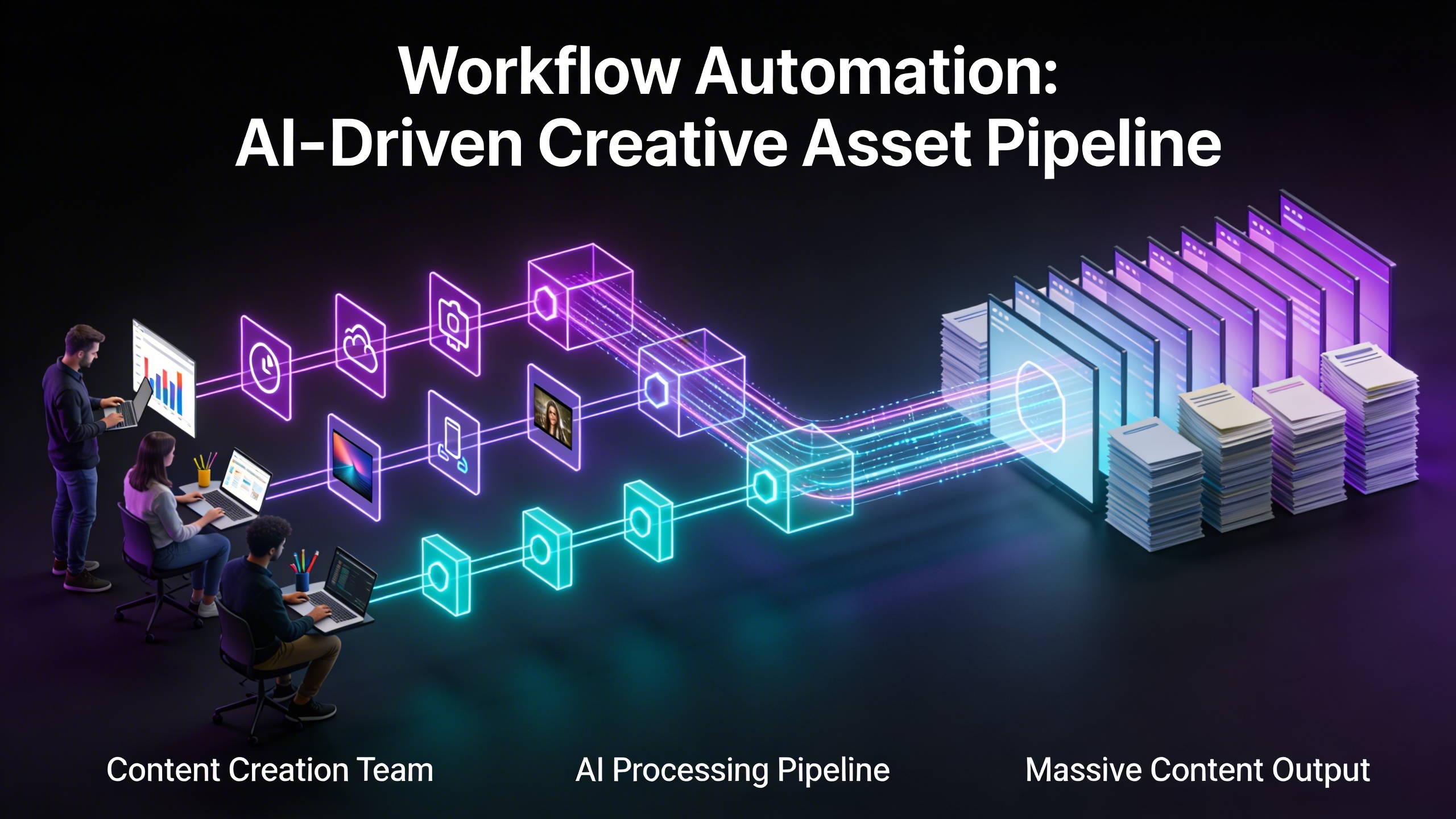
Stage 1: Brief-to-Research (Automated)
AI handles research and competitive analysis the moment a brief arrives. Keyword intent, audience data, competitive positioning — all assembled in minutes. The human team reviews and refines, rather than starts from scratch.
Tools doing the heavy lifting: AI search, structured research prompts, competitive analysis assistants.
Stage 2: Ideation and Scripting (AI-Drafted, Human-Directed)
AI generates first-pass creative concepts, scripts, and content structures. The team selects the strongest direction, adds brand voice and strategic nuance, and approves. What human effort replaces: the blank-page paralysis that adds hours to every project.
Stage 3: Asset Generation at Scale
Images, video, and copy are generated in parallel using AI tools. A single campaign brief can produce thirty visual variations in the time it used to take to source three stock images.
This is where multi-model platforms create the most leverage. Instead of switching between six tools with incompatible formats, a connected workflow produces images, video, and creative copy from a single canvas. For a complete breakdown of how to set up this kind of pipeline from scratch, see our step-by-step guide to building an AI-first content pipeline.
Batch your asset generation. Define your full visual palette, tone, and format variants before generating anything — then run the full set. This eliminates back-and-forth and keeps the visual language consistent across every deliverable.
Stage 4: Review and Refinement (Human-Owned)
Human review focuses on three things: strategic alignment with the brief, brand voice consistency, and factual accuracy. The review cycle shrinks from days to hours because the first draft is already 80% of the way there.
Stage 5: Distribution and Repurposing (Automated)
A single piece of content generates five to ten derivative assets automatically — social cuts, email versions, carousels, short-form video. The team defines templates once and the pipeline executes on every new piece. This alone multiplies effective output by 3–4× without additional creative work.
The Numbers Behind the Advantage
The economic argument for lean AI-augmented teams is not subtle.
| Metric | Traditional Agency (10-person) | AI-Augmented Team (3 people) |
|---|---|---|
| Monthly content output | 20–30 pieces | 80–120 pieces |
| Time per video ad | 3–6 weeks | 2–5 days |
| Cost per campaign video | $15,000–$30,000 | $2,000–$5,000 |
| Revision turnaround | 3–7 days | Same day |
| Cost per image asset | $200–$500 (stock/design) | $1–$3 (AI-generated) |
Design teams that have fully committed to AI-augmented workflows report doubling production speed, cutting project costs by up to 70%, and scaling output by 10×. These figures are consistent with what is being reported across the industry in 2026.
The traditional agency column uses industry-standard rates. Your actual savings will depend on your market, client mix, and tool stack.
The gap is widest in video production. A campaign video that required a full crew — director, DP, editor, colorist, sound designer — can now be produced end-to-end with AI-generated footage, AI-enhanced audio, and one human creative director for under $5,000.
What Big Agencies Are Getting Wrong
The agencies failing to adapt share three consistent failure modes.
1. Treating AI as a cost-cutting tool, not a capability multiplier. The teams winning with AI are not laying off their people and using AI to fill the gap. They are keeping their best people and using AI to multiply what those people can produce. The goal is growth, not reduction.
2. Adopting tools instead of redesigning workflows. Adding an AI image generator to a workflow built for stock photography does not change the economics. The teams seeing 10× output gains rebuilt their entire production sequence around AI capabilities from the start.
3. Underestimating the quality ceiling. The assumption that AI-generated content is detectably inferior is now two years out of date. In 2026, the quality ceiling for AI video, image generation, and copywriting has risen past what most human teams can sustain consistently at volume.
The rise of the new "creative ops" model — documented in the XainFlow report on AI-powered creative operations — is precisely this shift: human creative leadership directing AI execution at scale.
Key Takeaways
Whether you're a solo creator, a two-person studio, or a marketing team inside a larger organization, the opportunity is the same.
- AI levels the playing field at the execution layer. Quality and speed that used to require large teams are now accessible to anyone with the right stack.
- The constraint has shifted from production to direction. The scarce resource is no longer the ability to produce content — it's the strategic judgment to direct what gets produced and why.
- Volume is not the goal — leverage is. The point is not to produce 10× more content. It's to produce the right content, repurposed across more channels, with the same core team.
- Workflow architecture matters more than tool selection. Teams running integrated, multi-model pipelines consistently outperform teams using the same tools in isolation.
According to data collected across creative teams in 2025 and 2026, 87% of creators are now using AI in their production workflows. The gap between early adopters and the rest of the market is not closing — it is widening. The teams that made this transition in 2024 are now the benchmark everyone else is trying to match.
Build Your AI-Augmented Workflow
The workflow described in this post is not proprietary. It's replicable with the right tool stack and a willingness to redesign how work flows through your team. A connected platform that handles image generation, video generation, and workflow automation in a single canvas gives lean teams the execution infrastructure they need to compete with — and outperform — organizations ten times their size.